Mind Games: A Deep Dive into Tinder's Psychological Tactics
- Sahaj Kapoor
- Jul 9, 2023
- 3 min read

Updated: Jul 21, 2023

As a product manager, you wear many hats. You strategize, analyze, and execute to create the most engaging and beneficial user experience. One innovative approach to achieving this is through gamification, which refers to the use of game-design elements in non-game contexts. And a masterclass in applying this is provided by none other than the popular dating app, Tinder.
Today, let's delve into how Tinder uses gamification and principles of behavioral economics to influence user behavior, and how budding product managers can leverage these insights for their products.
Understanding the Power of Gamification
Tinder's success is not merely a result of its dating-focused functionality but also due to its highly engaging, game-like user experience. The use of elements like the Anchoring Effect, Loss Aversion, Social Proofing, and the Decoy Effect is instrumental in this.
The Anchoring Effect is the tendency for individuals to rely too heavily on an initial piece of information (the "anchor") when making decisions. Tinder uses this through their pricing structure. They present the premium versions Tinder Plus and Tinder Gold first, which are comparatively expensive, making the subsequent options appear more attractive and reasonably priced.
Loss aversion plays a role when users are faced with the prospect of losing a potential match. The fear of "missing out" on someone interesting prompts users to keep swiping and regularly check the app.
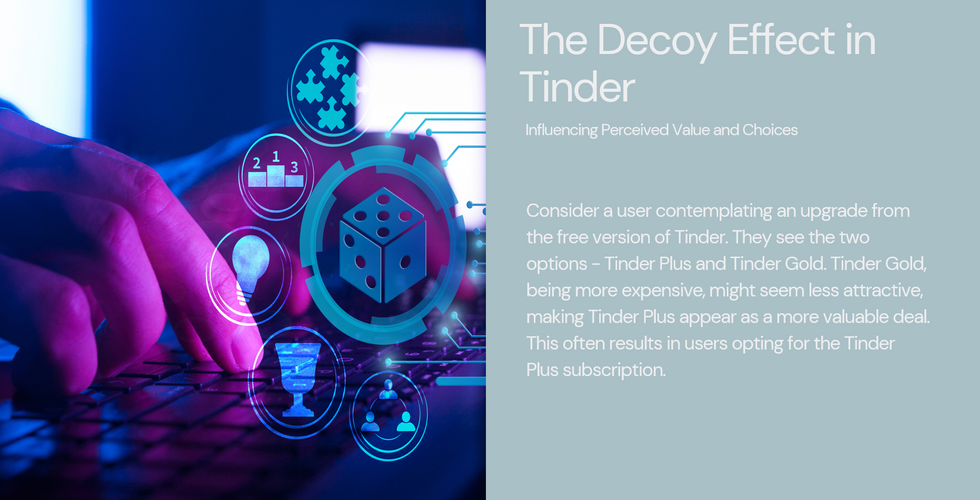
Social Proofing is implemented through Tinder's "Top Picks" and "Most Swiped Right" users, encouraging others to swipe right based on crowd behavior. The Decoy Effect, on the other hand, is used in Tinder's pricing strategy. Tinder Gold, priced just a little higher than Tinder Plus, but offering significantly more features, acts as a decoy to nudge users towards the Gold subscription.
Changing Behavior through Habit-Forming Models
Understanding users' current Pain, Gain, Habits, and Anxieties can be crucial to transitioning them from their current situation to the desired one. In the context of Tinder, the pain points might include loneliness or the need for companionship, and the gain is a potential relationship or interaction. The habit is regular usage of the app, and anxieties could be related to privacy concerns or the fear of rejection.
To tackle these factors, Tinder employs the B=MAT (Behavior = Motivation + Ability + Trigger) model. It motivates users with the prospect of meeting new people, simplifies the process with a user-friendly design (Ability), and nudges users to the app through notifications (Trigger).
Tinder also leverages the Hook Model, which consists of four stages - Trigger, Action, Variable Reward, and Investment. Internal triggers (like loneliness or boredom) and external ones (like push notifications) prompt users to use the app and engage in the simple action of swiping. The variable reward of getting a match brings excitement and encourages further usage.
Finally, users invest their time in building profiles and engaging with matches, making them more likely to return to the app.
Learning and Applying
The key takeaway for new product managers is to focus on understanding the users and their behavior. Identify the problems your users face, think about how your product can solve these issues, and use gamification principles to make this process engaging and interactive.
Consider various behavior models and techniques, such as B=MAT or the Hook model, to create a product that is not just useful but also habit-forming. Always remember, the goal is not only to solve a problem but also to provide a solution that is intuitive, engaging, and gratifying to use.
Finally, never stop learning. Keep observing successful apps like Tinder, understand their strategies, and don't hesitate to apply those insights to your product. Because at the end of the day, product management is about continuous learning, adapting, and delivering the best possible experience to your users.
You can refer to the full presentation below -




Comments